
Lessons from a Ferocious Learner
Inside The CodeBreaker Mindset™ podcast featuring Dr. Astro Teller, Alphabet, The Moonshot Factory, Co-Founder and Captain

The scientist who rewards teams for killing their own projects and built a planet changing innovation engine doing it
As we watched Artemis II and the Orion spacecraft take astronauts around the Moon and back to Earth, it is a reminder that exploration is not driven by knowing; but by learning.
Dr. Astro Teller, The Moonshot Factory's Co-Founder and Captain, is a proponent of ferocious learning, and has built one of the world's greatest innovation engines because of it.
More than twenty years ago, Dr. Astro Teller was the first person ever to tell me to write a book. So, when I sat down to write The CodeBreaker Mindset™, he was one of the first people I wanted to interview in-depth. No one I know embodies the courage to be “wrong” quite like he does.
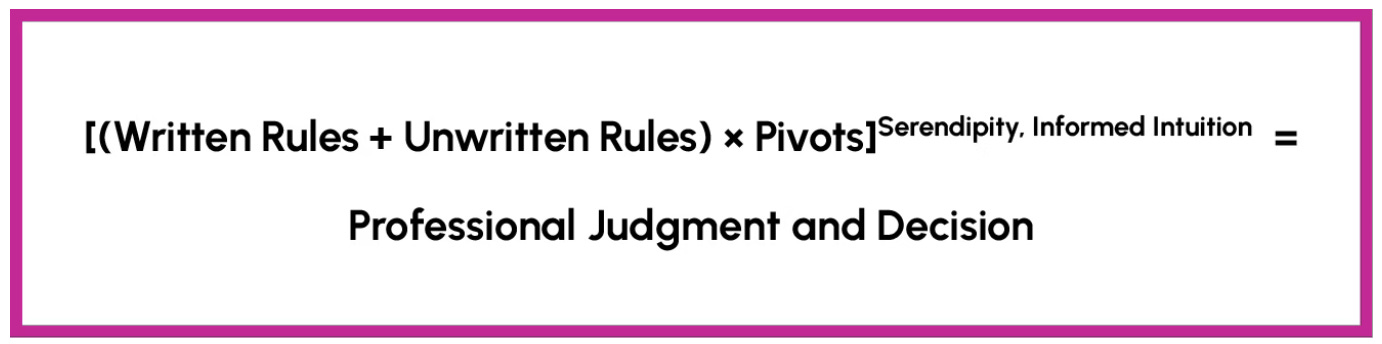
The CodeBreaker Mindset™ Equation
Dr. Astro Teller is the Co-Founder and Captain of X, Alphabet’s Moonshot Factory - the lab that birthed Waymo (self-driving cars), Wing (drone delivery), Google Brain, and Verily (life sciences).
His credentials read like a science fiction novel: PhD in artificial intelligence (AI) in the 1990s, serial tech entrepreneur, hedge fund founder, author, and holder of several hundred US patents. Both of his grandfathers were world-famous scientists; Dr. Gérard Debreu won a Nobel Prize, and Dr. Edward Teller was a founding father of the hydrogen bomb.
Astro’s first job? CEO.

The Path To Becoming A Moonshot Architect
Astro’s journey starts at Carnegie Mellon, where he pursued a PhD in artificial intelligence (AI), not because it was the hot field, but because it was the least understood.
“The part of computer science that benefited the most from creativity and exploration was the part that was the least well understood - which was AI.”
By graduation, he had three paths: become a full-time writer (he’d written a novel during his PhD), become a professor, or start a company.
The professorship offered stability. A clear trajectory. And that’s exactly what killed it for him:
“I could predict exactly who I’d be when I was 70. I just didn’t want that.”
Instead, he co-founded Sandbox Advanced Development - an early, prototype of X - which spun off Body Media, a wearable body monitoring company he led as CEO.
Then came the call from Larry Page and Sergey Brin: Would he help build a 21st-century Bell Labs?
X, The Moonshot Factory, was born.
The Identity Crisis That Changed Everything
Before becoming a CEO, Astro never had a job. No boss, no corporate playbook, no model for what leadership actually looked like. So he made one up.
“I conceived of being a CEO as being able to play speed chess with all of your employees at the same time. If I could do your job better than you could, then I could manage you.”
Spoiler: it didn’t work.
By the time his team hit 20 people, everyone was exhausted. Including him.
He faced a brutal choice: give up his identity as “the smart person in the room”, or give up being a CEO.
“I had to decide if I was going to give up how I conceived of myself and what counted as being an impressive person. Up to that point, I thought of being smart as what defined me. I was either going to give that up - and then, like, who am I? - or stop being a CEO.”
He chose to let go.
And what replaced “smartest person in the room”? A new identity: the most ferocious learner in the room.
“I don’t care how wrong I am now. I want to win in the long run. So the thing I’m going to hold myself to is: how ferociously are we going to learn?”
That single mindset shift became the foundation of X’s entire culture.
Inside X: The Moonshot Formula
Most companies say they want innovation. X actually has a system for producing it, and the rules are counterintuitive.
Rule #1: If it’s likely to work, we’re not interested
“If you come to me and you have an idea that sounds pretty good and like it’s likely to work, we’re not interested. If it’s likely to work, there are other groups that will do it cheaper and faster than us. That is not our superpower.”
X’s superpower? Exploring the unlikely, efficiently.
Rule #2: The Moonshot Story
Every project at X must answer three questions:
Huge Problem: What massive problem in the world are you solving? (If you can’t name it, what are you doing here?)
Radical Solution: What audacious solution would make the problem obsolete if it worked?
Testable Hypothesis: How can we quickly test whether this is crazy or genius? (A 1% chance of being right is fine. Years to find out is not.)
Rule #3: Audacity and Humility Must Be Equally High
“You are almost certainly wrong. That’s okay. What’s not okay is if you become in denial about the fact that you’re almost certainly wrong because you just want your baby to make it.”
The Standing Ovation for Failure
When a team kills their own project - because they’ve proven it won’t work - they get a standing ovation at the company all-hands.
“I still think there’s something here, but we just don’t have the proof. We’re ending it for right now. And you get to feel intellectually honest. And then people clap for you for being intellectually honest. Sadly, that is just not how the rest of the world works.”
But what about all that wasted effort?
X calls it “Moonshot Compost.” When a project dies, the people, code, patents, partnerships, and hardware don’t disappear. They become raw material for what comes next.
“It’s a challenge to us that there’s still value in these people, in these patents, in this code. What else could we do with it?”
Serendipity by Design: The Nairobi Lesson
One of X’s mantras: Get out into the real world as fast as possible.
Not just to find out if you’re wrong, but because the world is always different than you think, sometimes in unexpectedly good ways.
Case in point: X was testing laser-based wireless internet (free space optics) in a large apartment building in Nairobi. They offered unlimited internet at one-fourth the market price.
Everyone would buy this, right?
Wrong. After months, only 10 out of hundreds of apartments had signed up.
Total failure? Not quite. Those 10 apartments were buying unlimited internet, and reselling it to all their neighbors at a profit.
“We could have chosen to think of that as a bad thing. But we decided: what if we see all of our customers as prospective entrepreneurs? Let them spread it for us and take some profit on the way.”
A “failure” became a business model insight, but only because they were in the field early enough to discover it.
The Self-Hijacking Question
I asked Astro about moments when he was “hijacked”, derailed by self-sabotage or external pressure.
His response reframed the question entirely:
“I don’t think another person can hijack you. The world is full of stressors. But when we react badly, that’s on us. We can’t blame that on the stressors.”
100% of hijacking, he believes, is self-hijacking.
When does it happen to him? When someone criticizes X in ways that feel political or unfair. In his best moments, he shows up curious. In his worst moments:
“I can get defensive, sad, combative even, because I’m trying to defend X from what I think is an onslaught. But those are my fears rearing their head. Bad habits which I try really hard to unlearn.”
The Big Three Takeaways
The Rules of the Game: Pursue the unlikely. Require audacity and humility in equal measure. Build “kill criteria” before you’re emotionally attached.
The Pivots: Let go of “being smart” as your identity. Replace it with “being a ferocious learner.” Get into the real world fast, not just to fail faster, but to discover what you couldn’t have imagined.
The Magic: When you celebrate truth over winning, reward letting go over holding on, and turn failure into compost - you create a culture where breakthroughs become inevitable.
What’s Next
Astro’s journey, accomplishments and impact is one of many that shaped The CodeBreaker Mindset™. In the coming weeks, I’ll share more interviews with renowned leaders and insights from the book.
🎧 Want to hear my full conversation with Astro Teller? Listen to this episode of The CodeBreaker Mindset™ podcast 👉 www.ChitraNawbatt.com
Thank you for tuning in!
Pre-order The CodeBreaker Mindset™ book
Connect with me on social: @ChitraNawbatt
Here’s to your CodeBreaker Mindset™ and success,
Chitra

Chitra Nawbatt is a unique multi-industry and multidisciplinary executive, recognized for her extensive expertise as a business launcher and builder, growth operator, investor and media creator. From advising Fortune 500 CEOs to pioneering innovation in technology and venture capital, she has proven time and again that vision, audacity, and execution can turn the impossible into the inevitable.
She is the author of The CodeBreaker Mindset™ book, and the creator, producer and host of The CodeBreaker Mindset™ show. The book provides a professional judgement and decision-making framework for accelerating business growth, leadership and career pivots. The podcast is where leaders share their pursuit journeys to life opportunities, business building and value creation, as well as the rules, pivots and serendipity that propel them forward.
Chitra has served on the President of the United States Advance Team (The White House) and as an Adjunct Professor at Rutgers Business School. She has a Certified Public Accountant (CPA) designation, and is a graduate of Harvard Business School, Harvard University and Rotman School of Management, University of Toronto.