
Beyond Exceptional: The CodeBreaker Mindset™ in the Age of Artificial Intelligence
Good is the New Baseline. Excellent is Mandatory.

The Normal Distribution or The Bell Curve
Leaders, educators and society have relied, implicitly or explicitly, on the logic of the normal distribution, popularly known as the bell curve, for centuries. Performance, talent, outcomes, and value creation were understood as a bell curve with a left tail of underperformance, a broad middle of average performance, and a right tail of excellence. That mental model has shaped how we educate and grade students, hire, promote, invest, allocate resources, operate and evaluate progress.
The Bell Curve
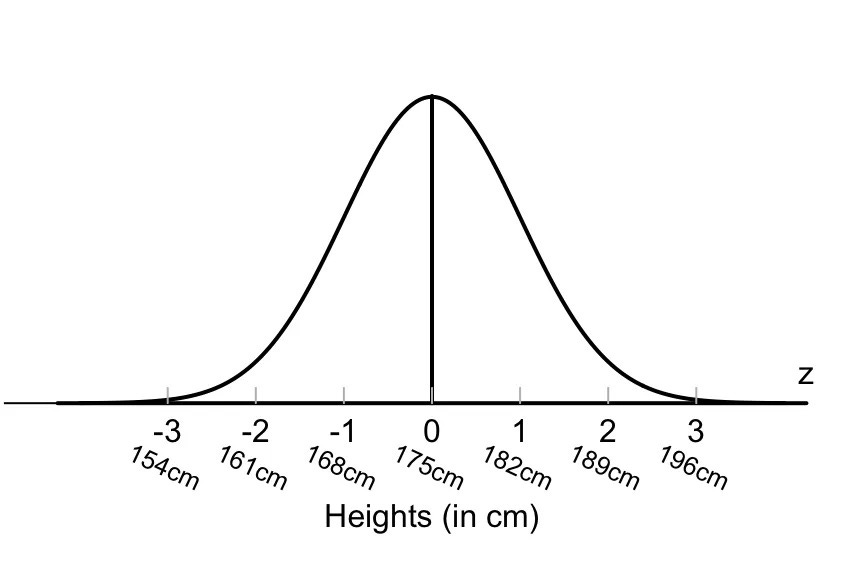
In my book, The CodeBreaker Mindset™, I reflect this concept where, “Many of us all over the world learned this in school, especially when teachers would tell us how they graded the class based on a curve. Using school grades as an example, the majority of students were in the middle, or average. A small number of students did poorly (the left tail). Very few students did well (the right tail). When we take the median score of students, it’s not those earning A’s that benefit from applying this curve, but the ones who are in the middle, scoring B’s and C’s. When the lowest common denominator wins, something in the success formula is broken. There are a few A players, a lot of B players, and some C players. So mediocrity or anything less than excellence rises the fastest.”
In the age of artificial intelligence (AI), not only is the bell curve a fast path to irrelevance and obsolescence, the model no longer holds.
What most leaders have not yet fully realized is that AI does not simply accelerate work or improve productivity at the margins. It changes the shape of the bell curve over time, and it changes the interpretation of the bell curve immediately. These two shifts are related, but they operate on different timelines, and confusing them creates delayed action in the exact moment urgency is required.
The Normal Distribution Will Change Shape, Eventually
Over the long arc of time, the mathematics will catch up. AI enables access to infinite volumes of data, range of inputs and variables, permutations and combinations of analysis, and velocity of input and output modelling. It also changes the nature, scope, extent and speed of any algorithmic process.
As AI enables access to unprecedented volumes of data, infinite permutations and combinations of testing hypotheses, continuously learning systems, and detecting patterns that were previously invisible or impractical to measure, the statisticians and quantitative experts will eventually redefine what the “normal” distribution looks like in an AI-saturated world.
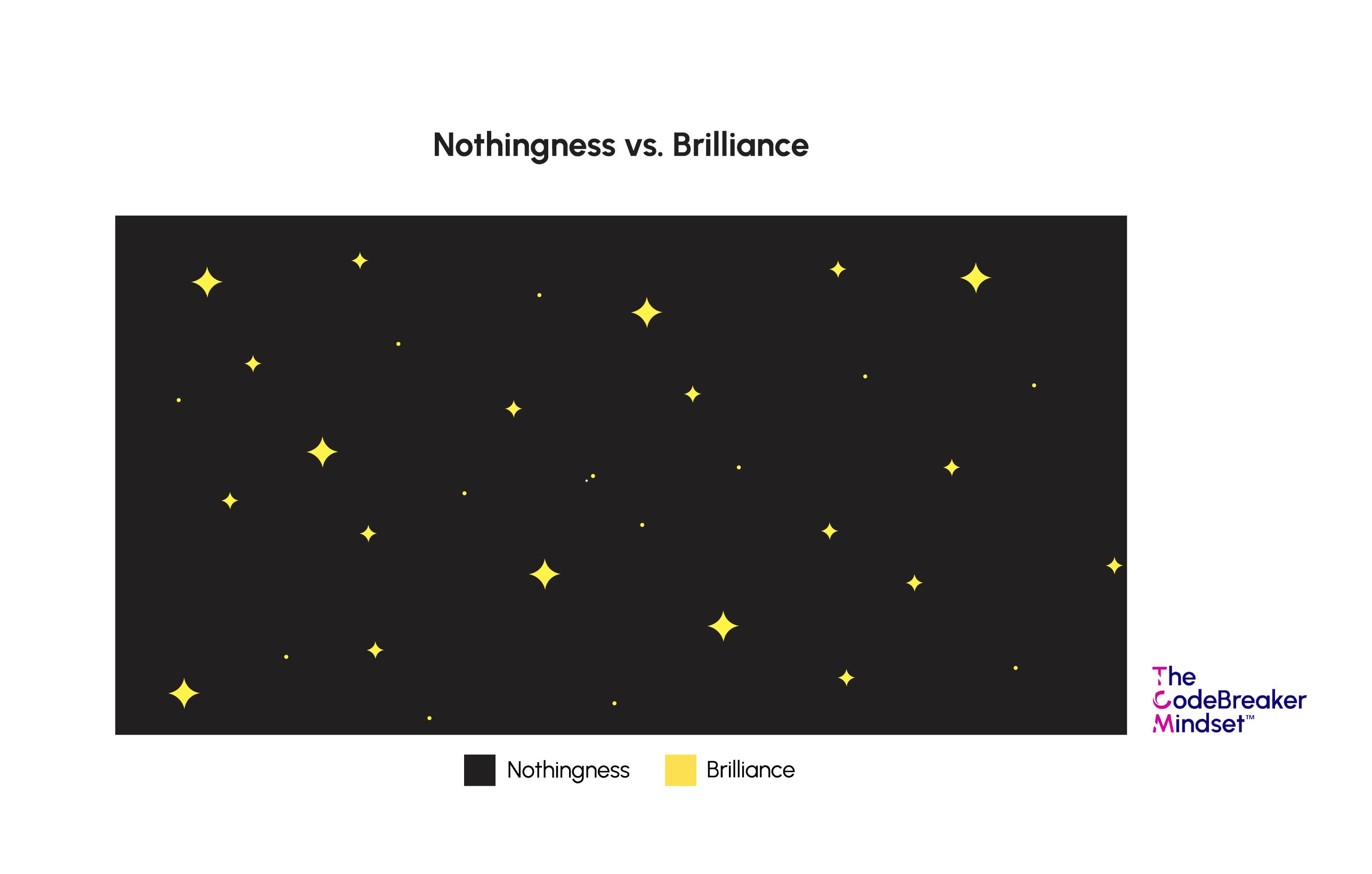
Over time, the bell curve itself will stretch, skew, and perhaps flatten, fluctuate, bifurcate or multifurcate in ways we cannot yet precisely model. Perhaps the normal distribution may be obliterated to points of that which is “exceptional”, and everything else is dark, inconsequential mass. Think of the night sky, where the stars are bright lights in a sea of black space of nothingness. Perhaps a dramatic view, but we are already on the slow train to this eventuality.
The formal work of measurement, monitoring, and empirical validation will take time, and the definitive articulation of a new curve may be decades away. It may be completed long after today’s leaders, and this author, are gone.
That future recalibration matters, but waiting for it misses the far more urgent reality leaders face right now.
The opportunity is to recognize when the rules have changed before the data fully proves it. It is about understanding that curves, models, and benchmarks are only as useful as the judgment applied to them.
In the age of AI, the leaders who will be competitive and relevant will:
• Predict, read and act on these shifts and moves early
• Obliterate complacency
• Raise standards faster than structure, systems and cultures allow
• Act before the normal distribution or bell curve makes their position irrelevant
The bell curve has already broken. The only question left is how long will it take individuals, leaders, organizations and countries to catch up?
The Interpretation of The Normal Distribution in the Age of AI
While the shape of the bell curve will evolve over time, the meaning of the bell curve today has already shifted dramatically and irreversibly. Artificial intelligence has reset the competitive baseline for individuals, roles, functions, organizations, industries, cities and countries.
Capabilities, performance and output that once were distinguished as the “right tail”, including speed, access to information, analytical capacity, and productivity, are now broadly “average”, available and routine.
As a result, what used to qualify as good performance, increasingly registers as average, the new baseline or minimum.
Legacy versus Current Interpretation of Normal Distribution
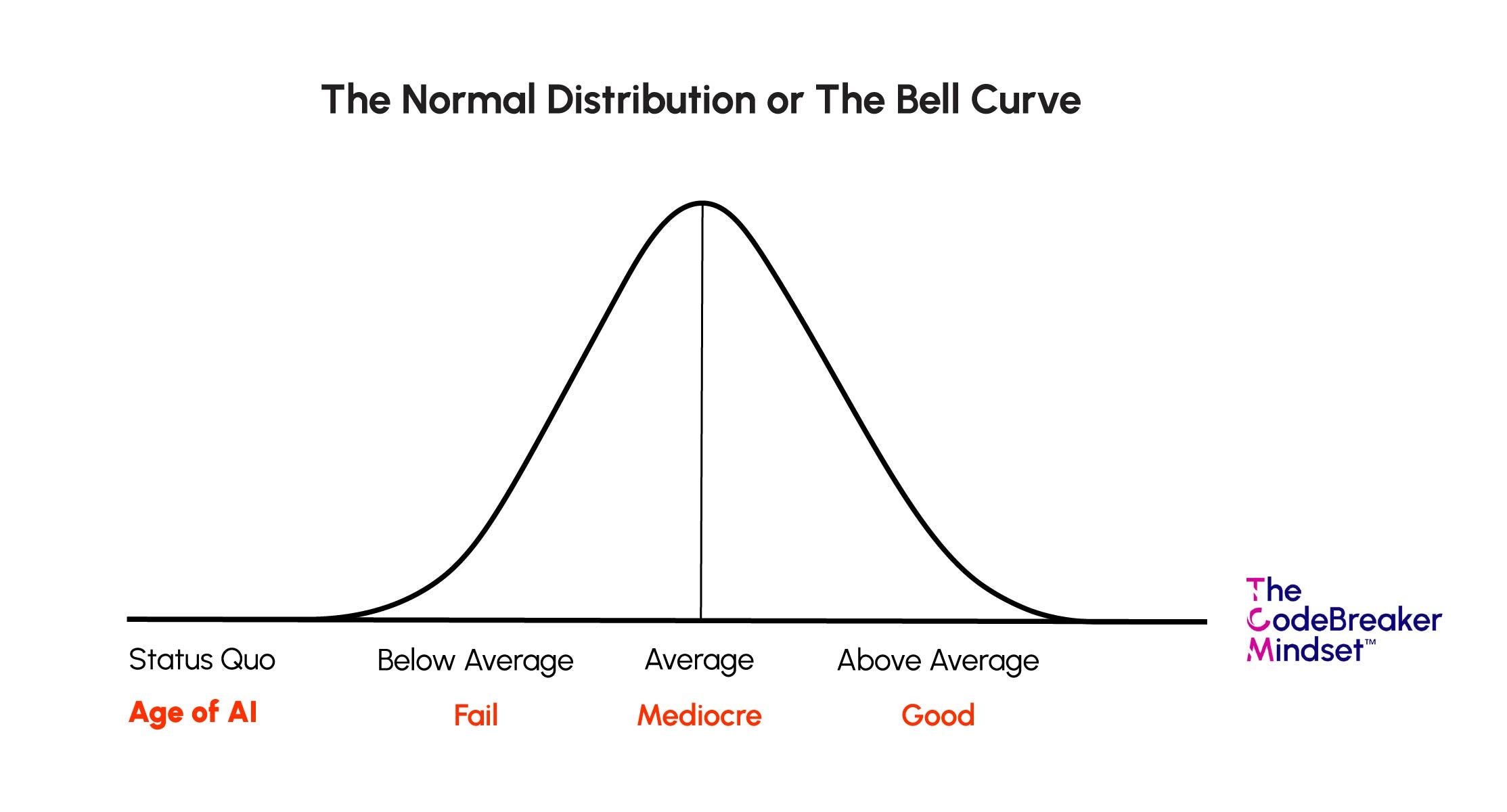
The “right tail”, or good, is now the new baseline or minimum.
The “average”, or the median, is now mediocre.
The “left tail”, or underperformance, is now a fail.
Stated plainly:
• What used to be good is now the minimum.
• What used to be average is now mediocre.
• What used to be mediocre is now a fail.
• And anything that is a fail is inconsequential.
The Updated Interpretation of Normal Distribution and Implications
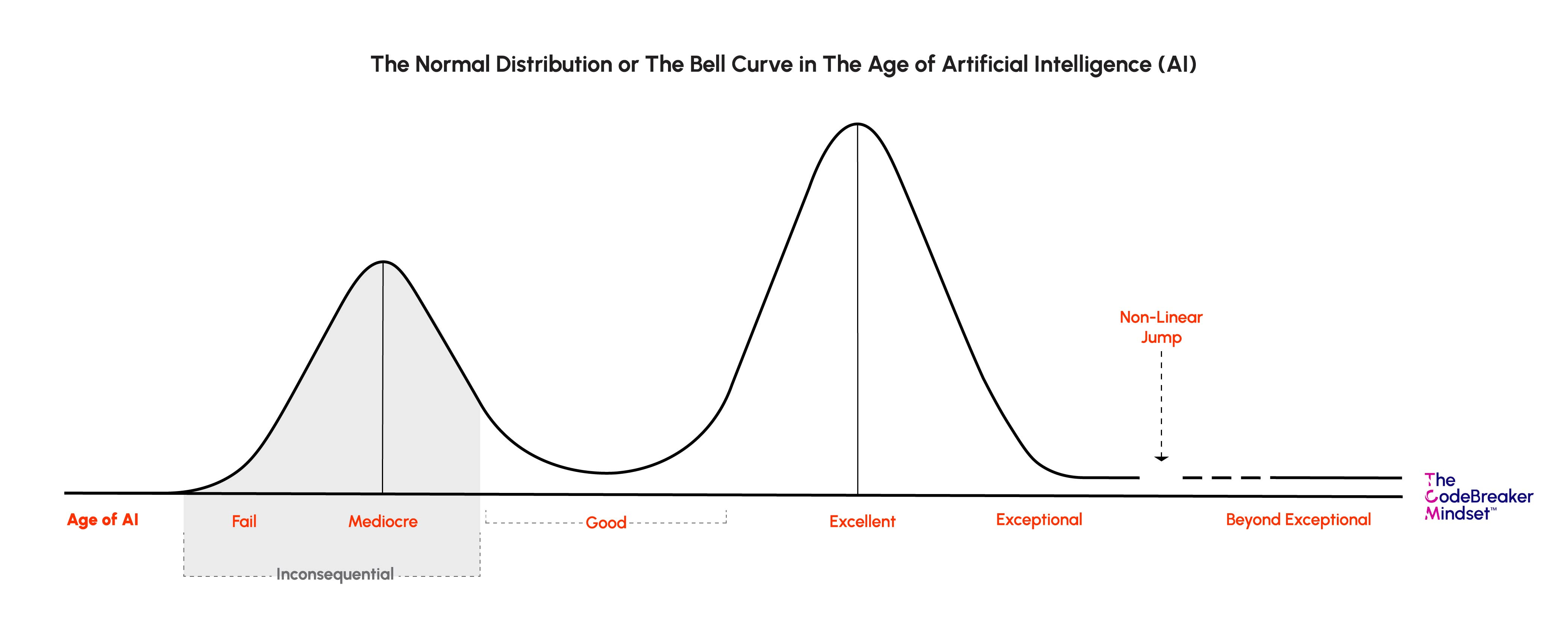
If you are not “excellent”, “exceptional” or beyond, you are not in the game.
And if you are not in the game, who will mentor and sponsor you? Relatively few people, if any, will have the time or appetite to mentor and sponsor “mediocre” or “fail”.
This is not rhetorical flourish. It is a structural shift driven by AI’s compression of advantage.
When intelligence, synthesis, and pattern recognition can be augmented at scale, the bar does not inch upward; it resets.
Organizations still evaluate themselves and their constituents and stakeholders using yesterday’s interpretation of the normal distribution or bell curve, while the AI-driven competitive environment is already operating under a new paradigm.
The Updated Interpretation of Normal Distribution Now Has Two Relevant States
• Excellent which is the new higher baseline for average
• Exceptional which is the new “right tail” in the bell curve
Why the Right Tail Is Collapsing Into the Mean
AI has collapsed the distance between competence and competence plus. Information is no longer scarce. Basic analysis is no longer differentiating. Even moderately sophisticated synthesis can now be generated quickly and cheaply.
Triangulation is “kindergarten”. In The CodeBreaker Mindset™, I discuss how “octagonulation” is now what has to be executed pervasively at scale, all of the time, to compete. “Octagonulation” is now the new norm for the winners.
The result is that the right tail is no longer protected by intelligent quotient (IQ), effort and execution alone. Excellence that is not paired with judgment, discernment, and originality is absorbed into the middle. AI has removed the prior barriers to the competitive advantage of speed. It is a race to the smartest, most holistic interpretation; the sharpest insight and decisions under uncertainty.
Dynamic multi-dimensional chaos and ambiguity are now the permanent norm requiring the best judgement and decision-making. A new core competency is pattern recognition, and more importantly, consistent proficient pattern recognition under dynamic ambiguity and pressure at scale.
By the way, why is pattern recognition not a core skill that individuals, educators, employers, etc. track, assess, cultivate, and measure?
Thus what is the pattern recognition or decision quality under risk and upheaval at scale?
The winners are those who can access and “octagonulate” the right data, that is data-driven, not perception or manipulation-driven; and precision-engineer the best professional judgment and decision-making.
The advantage increasingly belongs to the individual, team, organization or country that can take information and data, multiply and compute it through AI, and then apply judgment to determine what matters, what is signal, what is noise, and what should be done next.
“Good to Great” Is No Longer The Game
Business author, Jim Collins, wrote Good to Great in an era when moving from good to great was a differentiator. In the age of AI, this frame of reference has evolved. It is no longer good to great. It is “excellent” to “exceptional”, and “exceptional” to something “beyond exceptional”, because the baseline keeps rising (see diagram above). In the age of AI, the “average” will keep advancing and levelling up.
The right tail will keep extending to the right. Competition will only become greater.
The winners will be those with an information and innovation competitive advantage, an analytical advantage, a discernment advantage, and a decision-making framework and pattern recognition advantage.
Implications for Individuals: Why Should You Care?
For individuals, this shift should provoke urgency, not panic. Where you once may have classified yourself as above average, you must now ask what that classification means in a world where many of the capabilities and differentiated characteristics that used to define the “right tail” are now available to everyone.
The opportunity is to evolve deliberately. Expand your knowledge, skills and analytical range. Develop and strengthen your pattern recognition. Widen your relationships and ecosystems. Invest in yourself with maniacal focus to that which is evidentially and substantively real and high quality, versus the noise and distorted information inundating us. Build decision frameworks that help you operate when the road map is incomplete.
Pivot yourself before an involuntary pivot. Pivot yourself before somebody else or something pivots you.
Equip yourself. Ready yourself for the present and future.
The imperative is clear: self-directed evolution.
There Is A Place For Everyone To Shine
On a positive note, there is a place for everyone. Using the same normal distribution framework, the “right tail”, “average” and “left tail” are not absolute. They are assessments and categorizations based on the context. Thus, you may be average, but in another context that same “average” is “excellent” or “exceptional”. You may be “left tail” or a fail in one context, but “average” or “good” or “excellent” in another.
Find and/or create the context where your unique self and all that you embody, through your knowledge, skills, abilities, relationships, resources and superpowers, are “excellent” or “exceptional” or “beyond exceptional”. That context could be in another country, city, industry, company, function, role, responsibility, etc. Find and/or create the intersection where you and your performance can shine.
Implications for Organizations and Leaders: Mediocrity Is Killing Faster Thank You Realize
The shift in the normal distribution is urgent for every country, government, entity (for profit or non-profit), and leader who wants to be competitive. In organizations, the more people you are responsible for is the greater risk faced due to people politics, inefficient systems and structures, and the general inertia common in large groups, such as Fortune 500 companies. The question is whether an organization has the judgment, courage, and urgency to disrupt itself, and specifically obliterate its’ own mediocrity first?
This also challenges entities to confront, repurpose or change the leaders, team members and stakeholders who champion mediocrity, especially through championing the status quo!
Any organization with one or more people becomes a natural hotbed for mediocrity. People, processes, and cultures tend to preserve the status quo. The CodeBreaker Mindset™ discusses how “the status quo is not your friend.” Legacy structure, systems, culture and incentives often reward bureaucracy, politics, fear-based hierarchies, predictability, compliance, and internal safety over challenge, truth, and excellence.
Organizations also often operate from scarcity-mindset and insecurity. That environment can produce haves and have-nots, gatekeeping, and the suppression of independent thinkers. Over time, these dynamics cultivate average to mediocre performance, with mediocrity rising faster than excellence, institutionalized as the widely accepted norm. Thus the normal distribution has been celebrated in these intersections, particularly the “average” and “left tail” by the belly of the organization. If you meet a CEO who does not acknowledge this, even in the highest “performing” companies, (s)he is not acknowledging the basic fundamentals of human dynamics.
AI does not soften this tendency. It exposes it. In an environment where average is now mediocre and mediocre is now obsolescence, any unit that protects the status quo is structurally at risk. To remain competitive, leaders must raise standards faster than the culture naturally allows and legacy know-how is equipped to handle.
Relevance?
If you are an entity or team leader, ask yourself if everyone will be relevant in the age of AI? What does it mean for your organization? Business models? People, processes, systems? Talent, productivity and outcomes?
First, acknowledge and embrace this updated interpretation of the normal distribution. Then determine what are the steps you need to make to educate your organization around the updated interpretation of the normal distribution, and importantly, redefine it in the context of your entity. Then establish new expectations of people, processes, systems, operating and outcomes around the new baseline of “excellent” (the new norm or “average”) and “exceptional” (the “right tail” and beyond).
Risk and reward mechanisms, incentives, and formal and informal power, influence and culture modalities all need to embrace, implement and execute the new baseline and paradigm.
Competitive Edge Evaluation and Mapping
Talent is your number one competitive edge. Quicker, data-driven, evaluation cycles are required, to assess and diagnose team members into “fail’, “mediocre”, “average”, “good”, “excellent” or “exceptional” by the new standards discussed in this article. Then, work with the individual or team to devise a structured program to address knowledge, skill, and competency gaps. This is “right-sizing” the organization in the age of AI.
Here’s an outline to spark ideas to action:
• Conduct talent assessment based on updated interpretation of the normal distribution into “excellent”, “exceptional” and “questionable”
• For those classified as “excellent” and “exceptional”, assess the knowledge, skills and support that you can provide to continue to optimize and advance this talent
• For “questionable”, this is an even further in-depth dive to determine where can any of these players be “excellent” or “exceptional”?
If they can, where are the roles in the organization for them? Move them into contexts where they can hit these 2 categories.
If the “questionable” cannot easily fulfil “excellent” or “exceptional”, identify any gaps in intelligent quotient (IQ), emotional quotient (EQ), cultural quotient (CQ), and holistic quotient (HQ) (see The CodeBreaker Mindset™), and across any aptitude dimension. Formulate and implement a robust training and coaching program to help team members get there, with structured milestones over a specific time horizon.
• For the subset that remain “questionable”, it’s a harder dialogue to redeploy this talent in other parts of the organization or ecosystem to help them find contexts in which they can be a “high performer”. It is in their best interests to be honest, accountable and collaborate to help the person situate in a context in which they can thrive.
• Everyone will benefit from the individual or team receiving upskilling in knowledge, resources, relationships, critical thinking, triangulation and more importantly “octagonulation” analytics, pattern recognition development and acceleration, and decision making in uncertainty at scale.
• Iterate as helpful and appropriate.
• The organization needs to assess if it has an acceptable “distribution” of the range of talent at the performance levels required of “excellent” and “exceptional” and beyond. In the age of AI, anything less is a competitive headwind to being of zero relevance.
• Each organization has to decide how much “average is the new mediocre” it wants to carry, absorb, sustain, and what the opportunity costs and risk/reward tradeoffs are.
Agents of Change: Coalition of the Winning for Future Relevance
Competitive edge evaluation and mapping of all ingredients, especially talent, can be a heavy lift to assess, operationalize, execute, and repeat in perpetuity. Thus, every organization can benefit from the “agents of change” and “galvanizers”. Here are some talent attributes leaders may want to embrace that signal a team member who is part of the “coalition of the winning for future relevance”:
• Positive outlier thinking and actions demonstrating the person is “outlier capable” and/or an “outlier architect”
• Actively and continuously expand their innovation and analytical range
• Dynamic and strong pattern recognition across domains, functions and contexts
• Proficient in building risk, reward and decision frameworks for ambiguity
• Seeking environments and people that sharpen the individual and are not status-quo
• Attitude and aptitude to progress and elevate individual and team performance to succeed
• Abundance mindset and the type of person “who wants to win” not the type of person “who is afraid to lose”, as discussed in The CodeBreaker Mindset™
The choice is simple but unforgiving: pivot yourself, or be inevitably pivoted by external forces outside of your control.
Are you and those you surround yourself with equipped and prepared to be “excellent”, “exceptional” or “beyond exceptional” given the new interpretation of the normal distribution in the age of AI?
What steps are you, your team, community and ecosystem taking to be relevant, compete and win in the age of AI?
To discuss and learn more, read The CodeBreaker Mindset™ and contact me at www.ChitraNawbatt.com.
Thank you for tuning in!
Connect with me on social: @ChitraNawbatt
Here’s to your CodeBreaker Mindset™ and success,
Chitra
Chitra Nawbatt is a unique multi-industry and multidisciplinary executive, recognized for her extensive expertise as a business launcher and builder, growth operator, investor and media creator. From advising Fortune 500 CEOs to pioneering innovation in technology and venture capital, she has proven time and again that vision, audacity, and execution can turn the impossible into the inevitable.
She is the author of The CodeBreaker Mindset™ book, and the creator, producer and host of The CodeBreaker Mindset™ show. The book provides a professional judgement and decision-making framework for accelerating business growth, leadership and career pivots. The podcast is where leaders share their pursuit journeys to life opportunities, business building and value creation, as well as the rules, pivots and serendipity that propel them forward.
Chitra has served on the President of the United States Advance Team (The White House) and as an Adjunct Professor at Rutgers Business School. She has a Certified Public Accountant (CPA) designation, and is a graduate of Harvard Business School, Harvard University and Rotman School of Management, University of Toronto.